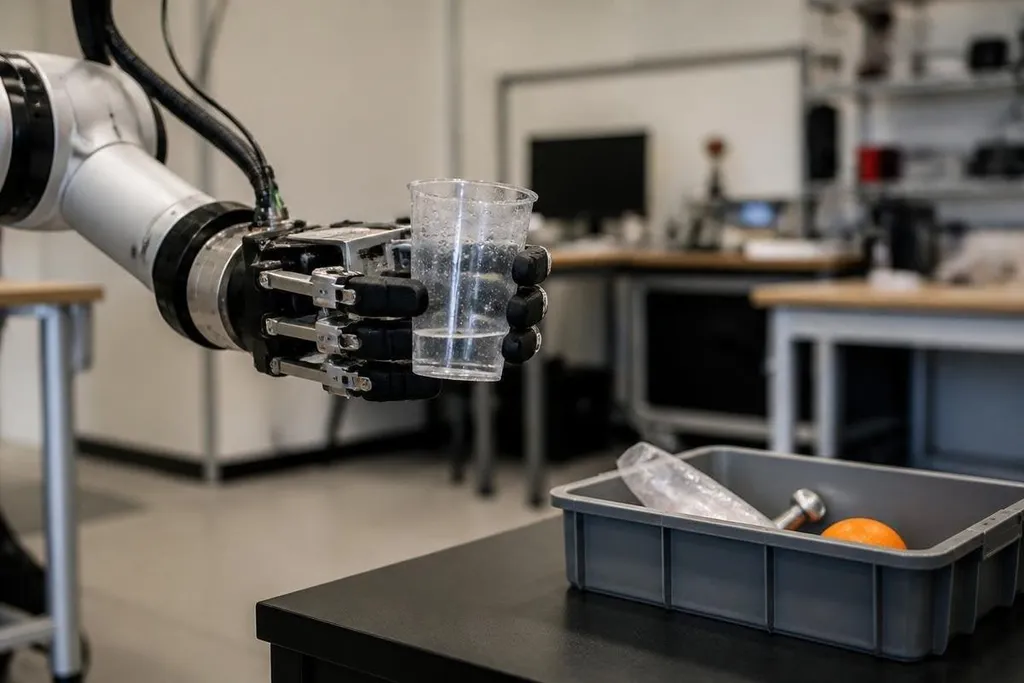
A robot hand can move a finger with great control and still fail to pick up a wet cup. The next step depends on touch, force control, and software that can react before an object slips. This matters to anyone planning automation around fragile, mixed, or changing objects.
- Vision finds the object; touch checks the grip.
- Force control keeps a hand from crushing thin parts.
- Useful robot hands need tests outside fixed lab demos.
Why fingers alone aren't enough
A camera can show where an object sits, but it can't fully describe how hard the hand should press. A clear plastic bag, a metal bolt, and a soft fruit may all need different grip forces, even when they look similar in an image.
That is where tactile sensing comes in. Sensors in the fingers can detect contact, pressure, vibration, or small changes in force. The control system can then slow a finger, move it, or loosen the grip before the object breaks or falls.
The hand also needs a way to spread force across several contact points. A rigid gripper may work well for a box with flat sides. Movable fingers can adjust around objects with uneven shapes, though each extra joint adds motors, wiring, software, and more parts that can fail.
The software has to react quickly
Touch data has value only when the robot can act on it. The control loop reads sensor input, compares it with the planned movement, and sends new commands to the motors. A delay can turn a safe grip into a dropped part.
Robot hands will need shared control between vision, touch, and motion. Vision can guide the hand toward a handle. Contact sensors can confirm that the fingers reached it. Force feedback can then keep the grip steady while the arm lifts.
This work also needs better test tasks. A video of one successful pick says little about how the hand handles ten object shapes, a changed surface, or a part placed a few centimeters away from its expected position.
Those tests give you a better way to judge new hand designs. Robot24.com hand robotics reporting can connect each design to its task, test setting, and reported limits before the mechanical problems begin.
The mechanical problems remain
A robot hand must fit inside a useful space, carry its own motors, protect its sensors, and survive repeated contact.
Those demands pull in different directions. Larger motors can raise grip force, but they also add weight to the wrist and arm.
Wiring is another weak point. Fingers bend many times, so cables and flexible circuit boards face repeated movement. A short demonstration may work well until it has to repeat the same motion through many work cycles.
Cleaning and repair matter too. A hand used around food needs surfaces that can be cleaned. A hand used in a factory needs parts that technicians can replace without removing the whole arm. Robot makers that leave these details out haven't shown a finished work tool.
The price also needs a clear test. A hand that costs more than the task can return won't help an operation, even if its movements look natural. A simpler two-finger gripper may remain the better choice for boxes, trays, and other repeatable loads.
A practical buying check
Before you plan around a robot hand, check these points against the task:
- Object range: Write down the smallest, largest, softest, and most slippery items it must hold.
- Grip feedback: Ask which sensors measure contact or force, and where those sensors sit.
- Failure response: Check what the hand does after a slip, blocked finger, or lost sensor signal.
- Service work: Confirm how technicians replace finger pads, motors, cables, and sensor parts.
- Task proof: Ask for results across changed object positions and surfaces, not one repeated pick.
- Total cost: Include the arm, control software, safety equipment, spare parts, and setup time.
That list separates a hand built for a demonstration from one suited to a work cell. It also gives you a way to compare a dexterous hand with a simpler gripper without judging either by appearance.
I’d choose the least complex hand that can handle the real objects, then add touch sensing where failure costs more than the hardware.
The next useful milestone is a public test that reports grip success, damage, recovery time, service intervals, and cost across the same task set. Until those numbers are available, robot hands remain promising hardware with an unfinished proof.